

Dental Inlays and Onlays in Wakad – Precision Restorations at Patil's Dental Care
Home / INLAYS AND ONLAYS
Dental inlays and onlays in Wakad are indirect ceramic or composite restorations offered at Patil's Dental Care. An inlay fills within the tooth cusps; an onlay covers one or more cusps. Both are stronger than direct fillings and more conservative than full crowns, ideal for moderately damaged back teeth.
What Are Inlays and Onlays - And Why Are They Sometimes Better Than Fillings?
Most patients are familiar with dental fillings. They are direct restorations - material placed into a cavity and shaped by hand in the mouth, usually in a single appointment. Fillings work well for small to medium cavities. But when a cavity or tooth damage is large, a direct filling may not provide enough strength or longevity. At the same time, the tooth may not be damaged severely enough to warrant a full crown, which requires significant removal of healthy tooth structure.
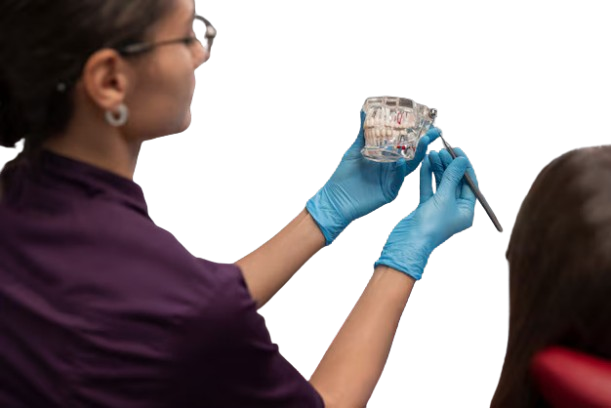
This is where inlays and onlays come in. They are indirect restorations - meaning they are fabricated outside the mouth in a dental laboratory, precisely fitted to the prepared tooth and then cemented in place. This precision fit and the quality of laboratory-fabricated ceramic materials give them significant advantages over direct fillings for mid-sized restorations.
An inlay sits within the cusps of a tooth (the raised points on the biting surface) - it is essentially a precision-fitted insert into the tooth's centre. An onlay covers one or more of the tooth's cusps, extending to protect a larger portion of the tooth's chewing surface. When an onlay covers all cusps, it becomes functionally similar to a crown, but is still considered an onlay if the sides of the tooth remain mostly intact.
At Patil's Dental Care in Wakad, inlays and onlays are fabricated from high-quality dental ceramic, which matches the tooth colour naturally and wears similarly to natural enamel.

When Is an Inlay or Onlay the Right Choice?
Dr. Patil typically recommends inlays or onlays in the following situations: an old large amalgam (silver) filling that is cracking or failing and needs replacement, a cavity that is too large for a reliable direct composite filling but the tooth structure remaining is sufficient to avoid a full crown, a tooth with cracks on the cusp tips that need to be covered to prevent fracture progression and patients who want long-lasting tooth-coloured restorations on back teeth.
The advantages of inlays and onlays over large direct composite fillings are well-documented in dental literature. Laboratory-fabricated restorations have better marginal fit (less gap at the tooth edge, meaning less chance of leakage and secondary decay), better wear resistance and better reproduction of the natural tooth anatomy and bite contact.
The Inlay and Onlay Procedure at Patil's Dental Care
Like crowns and bridges, inlays and onlays require two appointments. At the first visit, the damaged or decayed tooth is prepared, all decay is removed and the cavity is shaped to receive the inlay or onlay. An impression (or digital scan) is taken of the prepared tooth and sent to the dental laboratory. A temporary filling protects the tooth in the interim.
At the second appointment (typically 7-10 days later), the temporary filling is removed, the inlay or onlay is tried in to check fit, shade and bite and then cemented permanently. The bite is checked again after cementation and any minor adjustments are made.
The result is a restoration that fits precisely, looks natural and is likely to last 10-20 years with good oral care - significantly longer than a large direct composite filling in the same position.

Caring for Teeth with Inlays and Onlays
Inlays and onlays require the same care as natural teeth: brushing twice daily, flossing around the restoration and regular check-ups. They do not decay themselves, but the natural tooth structure at the margins can still develop cavities if oral hygiene is poor. Grinding (bruxism) is the biggest threat to inlay and onlay longevity - patients who grind should ask Dr. Patil about a night guard to protect their restorations.